← Back to Products

Planar Halbach Arrays

2D flat array panels for high-force surface applications.

Target Buyer:Manufacturing equipment designers and automation engineers.
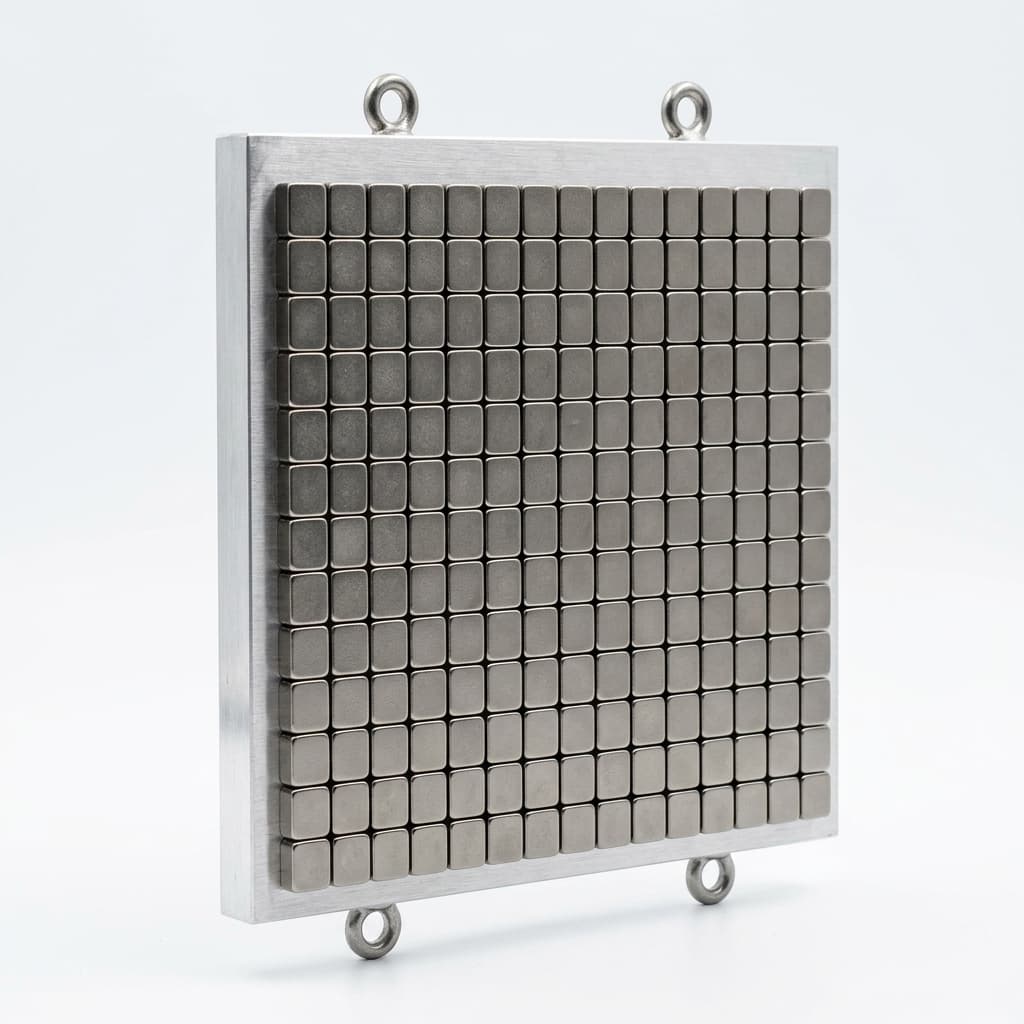
Single-sided planar Halbach magnet array with precision grid layout

Best-Fit Procurement Use

Best fit when the buyer needs high field concentration over a defined work face while protecting electronics, carriers, or mounting hardware behind the array.

Capability Highlights

  • High flux concentration on one face
  • Reduced magnetic leakage on the back
  • Customizable pole grid layouts

Typical Applications

  • Magnetic fixtures
  • Planar motors
  • Semiconductor wafer handling

Engineering Focus

  • Surface flatness and mechanical rigidity
  • Grid spacing tolerances
  • Corrosion protection
  • Back-side leakage control near sensors and electronics

Buyer Decision Criteria

  • Active area, grid pitch, and required working height above the surface.
  • Back-face leakage limit for nearby sensors, PCBs, or fixtures.
  • Flatness, parallelism, and mounting datum control for large plates.
  • Coating and sealing needs for cleanroom, humidity, or chemical exposure.

Factory Capability

  • 2D grid assembly with orientation checks before final potting.
  • Rigid non-magnetic backing plates to control plate warpage.
  • Epoxy, NiCuNi, or Parylene coating selection by environment.
  • Custom hole, slot, and datum machining for OEM integration.

Key Evaluation Matrix

MetricTypical RangeWhy It Matters
Back-face Leakage< 5%Protects sensitive electronics mounted behind the array.
Active Face FlatnessProject-specific by panel size and mounting datumFlatness controls air-gap consistency for planar motors, fixtures, and wafer-handling tools.
Holding Force / Working HeightValidated at the specified distance above the active faceBuyers need force at their real operating height, not a generic pull value at contact.

RFQ Checklist

  1. Area dimensions (L x W)
  2. Grid layout requirements
  3. Desired holding force / field strength
  4. Working height, back-side leakage limit, mounting holes, and coating needs

Risk Controls

  • Warping during assembly: Use of rigid non-magnetic backing plates (e.g., thick Aluminum or Stainless Steel).
  • Unexpected magnetic leakage into nearby electronics: Add back-face leakage checks and adjust magnet thickness, carrier, or shielding where needed.
  • Grid orientation error: Use orientation marking, pre-bonding checks, and 2D field mapping before shipment.

Validation Deliverables

  • 2D surface field map with working height notes.
  • Back-side leakage measurement where required.
  • Flatness and critical dimension inspection.
  • Coating and sealing process notes for approved samples.

RFQ to Delivery Flow

  1. Send active area, grid pitch, working height, mounting pattern, and leakage limits.
  2. We check whether the target field requires grade, thickness, or layout changes.
  3. Prototype plates are measured for flatness and magnetic output before approval.
  4. Production fixtures lock grid orientation and datum references for repeat orders.

Product Gallery

Planar Halbach array fixture
Planar Halbach magnetic plate
One-sided flux Halbach levitation plate
Planar Halbach array isometric engineering illustration
Planar Halbach array top-view pole grid

Buyer FAQ

Are custom grid sizes available?

Yes, we can CNC machine magnets to any specific dimension to match your required pole grid.

Can you validate field strength above the plate surface?

Yes. The useful measurement point is normally the working height above the active face, and it can be included in the inspection plan.

Which carrier materials are common for planar arrays?

Aluminum, stainless steel, and non-magnetic composite carriers are common; the best choice depends on stiffness, corrosion, mass, and mounting needs.

Related Resources

Engineering RFQ Inbox

[email protected]

Include target torque/speed, quantity, and delivery location.

Direct Engineer Chat

WhatsApp Engineering Support

Use for drawing, specification, and RFQ clarification.