← Back to Solutions

Voice Coil Actuators

High-bandwidth, direct-drive linear motion using Halbach arrays.
Target Buyer:Precision automation and photonics engineers.
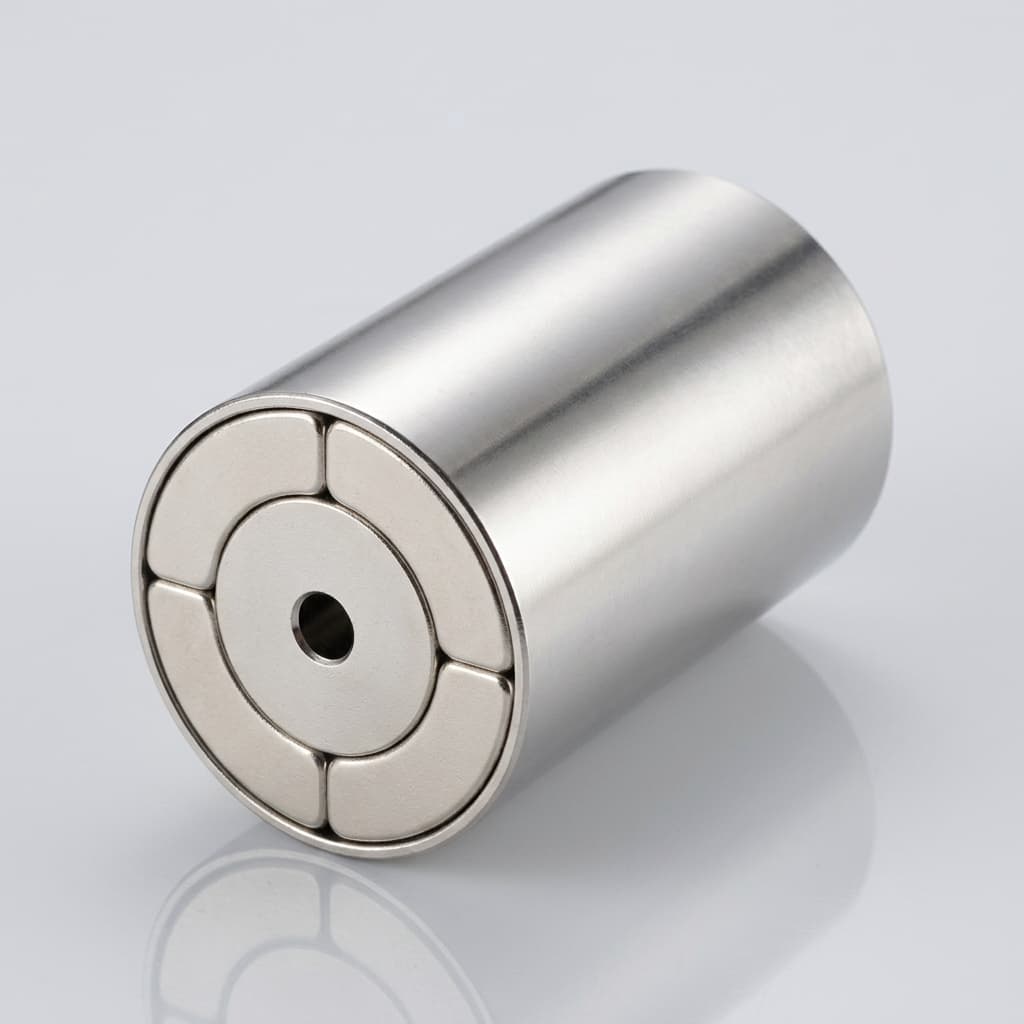
Halbach voice coil actuator

Best-Fit Application Use

Best fit for precision automation teams that need high acceleration, low cogging, and predictable field output in a compact actuator envelope.

Solution Highlights

  • Zero cogging
  • Extreme acceleration capability

Common Use Cases

  • Semiconductor wire bonding
  • Optical focusing stages

Implementation Focus

  • Moving mass minimization
  • Thermal management of the coil
  • Low ripple field over the active stroke
  • Carrier flatness and datum alignment

Buyer Decision Criteria

  • Stroke, peak and continuous force, air gap, and bandwidth target.
  • Moving mass, coil heat, and allowable magnet temperature.
  • Flatness, carrier stiffness, and alignment datums.
  • Field mapping method for the active stroke.

Factory Support Scope

  • Compact linear and planar Halbach stator assemblies.
  • Magnet sorting and fixture bonding for low ripple.
  • Carrier machining for precision optical or semiconductor stages.
  • Field maps for the useful stroke and working gap.

Application Evaluation Matrix

Evaluation MetricTypical RangeBuyer Relevance
BandwidthProject-specific by stroke, moving mass, and coil designDetermines the practical frequency of reciprocating motion for the full actuator.
Force RippleDefined by optical, bonding, or positioning toleranceRipple creates tracking error in high-bandwidth direct-drive stages.
Moving Mass ImpactReviewed with coil and carrier designLower moving mass improves acceleration and settling time in VCM systems.

RFQ Preparation Checklist

  1. Required stroke
  2. Continuous and peak force
  3. Air gap, bandwidth target, and moving mass limit
  4. Coil heat assumptions and field map height over active stroke

Risk and Mitigation

  • Coil overheating: Optimized air gap and forced air cooling options.
  • Field profile not aligned to active stroke: Map the field over the actual stroke and working gap, not only at the magnet face.
  • Mechanical misalignment in optical or semiconductor stages: Use CNC datum carriers and flatness checks before final assembly approval.

Validation Deliverables

  • Working-gap field map over the active stroke.
  • Carrier flatness and critical dimension inspection.
  • Grade, coating, and adhesive process notes.
  • Prototype-to-production inspection plan.

RFQ to Delivery Flow

  1. Send stroke, force, bandwidth, gap, coil heating assumptions, and envelope.
  2. We review pitch, grade, and carrier strategy for low ripple output.
  3. Prototype mapping supports actuator force testing.
  4. Production repeats matched magnet sorting and fixture controls.

Recommended Products

Linear Halbach actuator track
Halbach array VCM actuator

Buyer FAQ

Do you supply the moving coil as well?

We typically supply the permanent magnet stator track, but can partner for complete assemblies.

Why use a Halbach array in a voice coil actuator?

A Halbach stator concentrates flux in the working gap, improving force density while reducing stray field on the opposite side.

What validation data is most useful for VCM buyers?

A working-gap field map over the active stroke is more useful than a single peak surface-field value.

Related Resources

Engineering RFQ Inbox

[email protected]

Include target torque/speed, quantity, and delivery location.

Direct Engineer Chat

WhatsApp Engineering Support

Use for drawing, specification, and RFQ clarification.