
Halbach Array vs. Traditional Magnets: When to Choose Which
An engineering comparison between Halbach arrays and traditional multipole magnet rotors for BLDC motors, eVTOLs, and industrial applications.
When designing high-performance electric motors, linear actuators, or magnetic couplings, engineers inevitably face a critical decision at the magnetic topology stage: should you use a traditional alternating-pole magnetic arrangement or invest in a Halbach Array?
In this technical guide, our engineering team at HalbachArray breaks down the fundamental physics, key advantages, and cost-benefit trade-offs. We provide a quantifiable framework to help your procurement and design teams make the right choice before freezing your Bill of Materials (BOM).
1. The Underlying Physics: Flux Distribution
A traditional multipole magnet rotor alternates North and South poles (N-S-N-S). While simple and cost-effective to manufacture, this configuration results in magnetic flux "leaking" equally onto both the working face (the air gap) and the non-working face (the back side). To prevent this wasted flux from causing EMI issues and to complete the magnetic circuit, a heavy ferromagnetic steel back-iron (yoke) is strictly required.
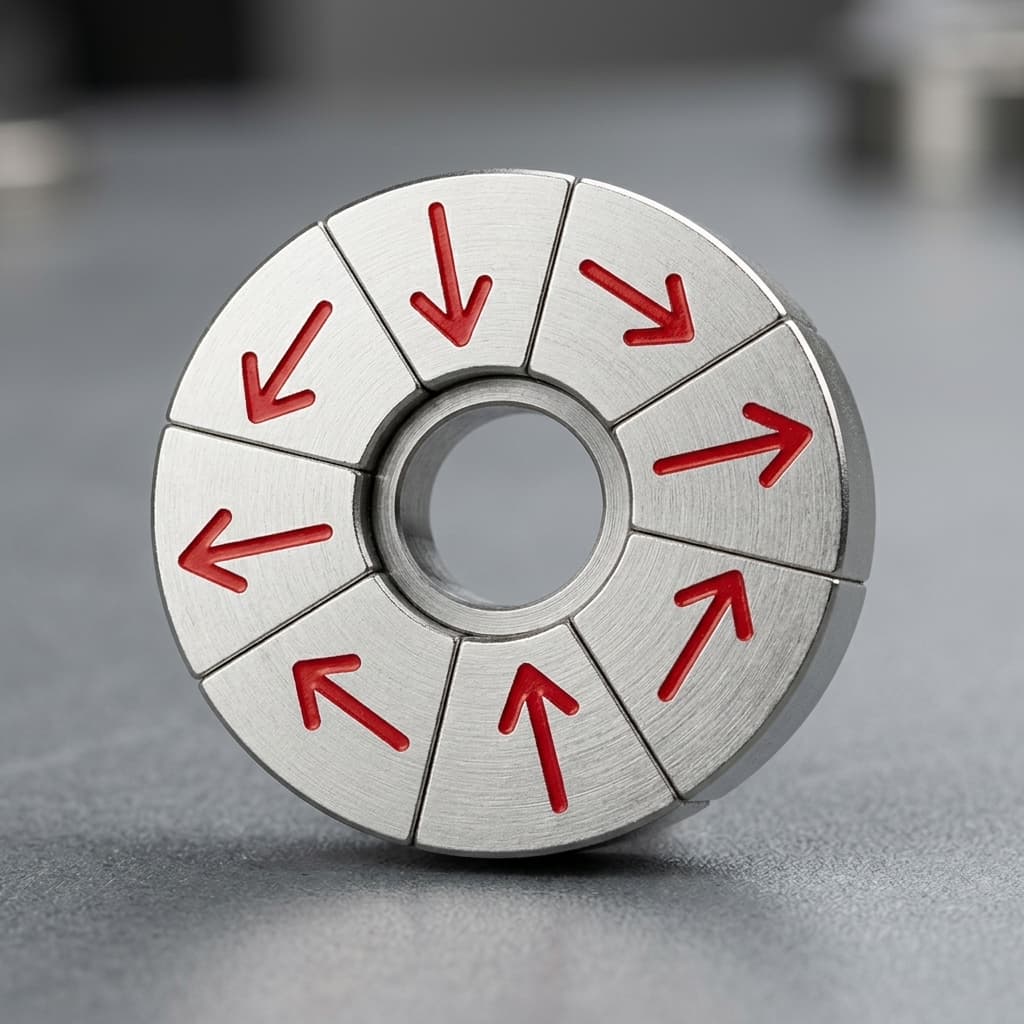
A Halbach Array, invented by Klaus Halbach, is a specialized arrangement of permanent magnets where the magnetization vector of each successive magnet is rotated by a specific angle (typically 90°, but advanced designs use 45° or 60° increments).
This topological arrangement produces a highly desirable phenomenon known as one-sided flux concentration:
- Working Face: The magnetic flux vectors constructively interfere, resulting in a stronger, nearly sinusoidal magnetic field.
- Non-Working Face: The magnetic flux vectors destructively interfere, reducing the field on the opposite side.
Magnetic Flux Topology: Traditional vs. Halbach Array
2. Quantitative Comparison Matrix
To help engineering teams make a rapid assessment, we have compiled a benchmark matrix comparing a standard N52 Neodymium N-S-N-S rotor against a 90°-segment N52 Halbach rotor of identical magnetic volume.
| Engineering Metric | Traditional N-S-N-S Rotor | Halbach Array Rotor (90° Segments) | Engineering Impact |
|---|---|---|---|
| Peak Flux Density (Air Gap) | Baseline (1.0x) | ~1.3x to 1.4x higher | Higher torque/force output for the same footprint. |
| Back-Iron Requirement | Mandatory (Thick electrical steel) | Eliminated (Can use lightweight Carbon Fiber/Titanium) | Massive reduction in overall assembly weight. |
| Air Gap Flux Waveform | Trapezoidal / Square | Highly Sinusoidal | Drastic reduction in cogging torque and motor vibration. |
| Eddy Current Losses | High (in the steel yoke) | Very Low (no steel yoke needed) | Improved thermal stability at >10,000 RPM. |
| Assembly Complexity | Low (Automated placement) | Very High (Requires custom non-magnetic fixtures) | Higher NRE and unit assembly cost. |
3. Deep Dive into Key Advantages
A. Weight Reduction for Aerospace (The "Zero Back-Iron" Benefit)
For aerospace applications like eVTOL drones, satellite reaction wheels, and UAV gimbals, the motor's power-to-weight ratio is the ultimate KPI. Because a Halbach array intrinsically cancels the magnetic field on its non-working face, it does not require a heavy ferromagnetic back-iron to contain the flux. Engineers can mount the magnets directly onto a carbon fiber, aluminum, or PEEK resin carrier, stripping hundreds of grams off the motor's total weight.
B. Minimized Cogging Torque for Precision Robotics
A well-designed 45° or 60° segmented Halbach array naturally produces an extremely smooth, sinusoidal magnetic field distribution in the air gap. Traditional rotors often suffer from "cogging"—a jerky motion caused by the magnets snapping to the stator teeth. The sinusoidal wave profile of a Halbach array dramatically reduces torque ripple and acoustic noise, which is a hard requirement for surgical robots, semiconductor lithography stages, and optical scanning galvanometers.
Typical Review Finding: Torque Ripple
For compact robotic joints and medical motion systems, changing from a traditional rotor to a higher-segment Halbach pattern can reduce torque ripple when the air gap, pole count, magnetization angles, and stator assumptions are modeled together.
4. When Should You Stick to Traditional Magnets?
Despite its undeniable performance superiority, a Halbach array is not a universal silver bullet. You should opt for traditional magnets when:
- Cost is the primary constraint: Halbach arrays require more discrete magnet blocks. More importantly, assembling blocks that naturally repel each other requires specialized adhesive curing fixtures, significantly raising labor and NRE costs.
- Weight is irrelevant: In stationary industrial machinery (e.g., heavy conveyor belt drives or wind turbine generators), the extra weight of a steel back-iron is often negligible compared to the cost savings of traditional assembly.
- Standardized Radial Rings exist: Traditional multipole ring magnets can often be radially oriented in a single powder pressing process, which is extremely cheap at mass scale (millions of units).
5. OEM Sourcing Checklist for Halbach Arrays
If you have decided that a Halbach array is necessary for your next-generation product, you cannot simply buy raw magnets and glue them together in-house without severe safety risks and quality issues. Furthermore, you must select the right material—as we discuss in our guide to high-temperature magnet grades. When sourcing a Halbach OEM, verify the following:
- Angular Deviation Sorting: Does the supplier use a Helmholtz coil to pre-sort raw blocks, rejecting magnets with >2° magnetization angle deviation before assembly?
- Custom Assembly Fixtures (Jigs): Can the factory provide 3D CAD evidence of dedicated non-magnetic assembly fixtures designed to safely constrain the repelling blocks during the adhesive curing cycle?
- Structural Adhesives: Are they using aerospace-grade epoxies (e.g., Loctite) rated for your motor's peak operating temperature (e.g., 150°C)?
- 3D Gauss Verification: Will the supplier provide a detailed QA report showing the plotted B-field waveform across the X, Y, and Z planes?
At HalbachArray, we bridge the gap between complex engineering requirements and China's magnetic supply chain. We provide simulation-informed, tolerance-controlled magnetic assemblies.
Reach out to our engineering team with your STEP files and target B-field requirements at [email protected] to receive a DFM (Design for Manufacturing) review and quotation scope.
Author

Categories
More Posts
Understanding Neodymium Magnet Grades for High-Temp Rotors: N52 vs N42SH vs N38UH
A mechanical engineer's guide to selecting the correct NdFeB magnet grade for high-temperature operating environments to prevent irreversible demagnetization.
Designing Halbach Cylinders for NMR, MRI, and Scientific Research
Learn how to achieve highly uniform dipole or quadrupole magnetic fields inside a bore using discrete Halbach cylinder assemblies.
FEA Magnetic Simulation in Motor Design: How to Read a Flux Density Report
A practical guide for procurement and mechanical engineers on interpreting Finite Element Analysis (FEA) reports for magnetic assemblies and Halbach arrays.