
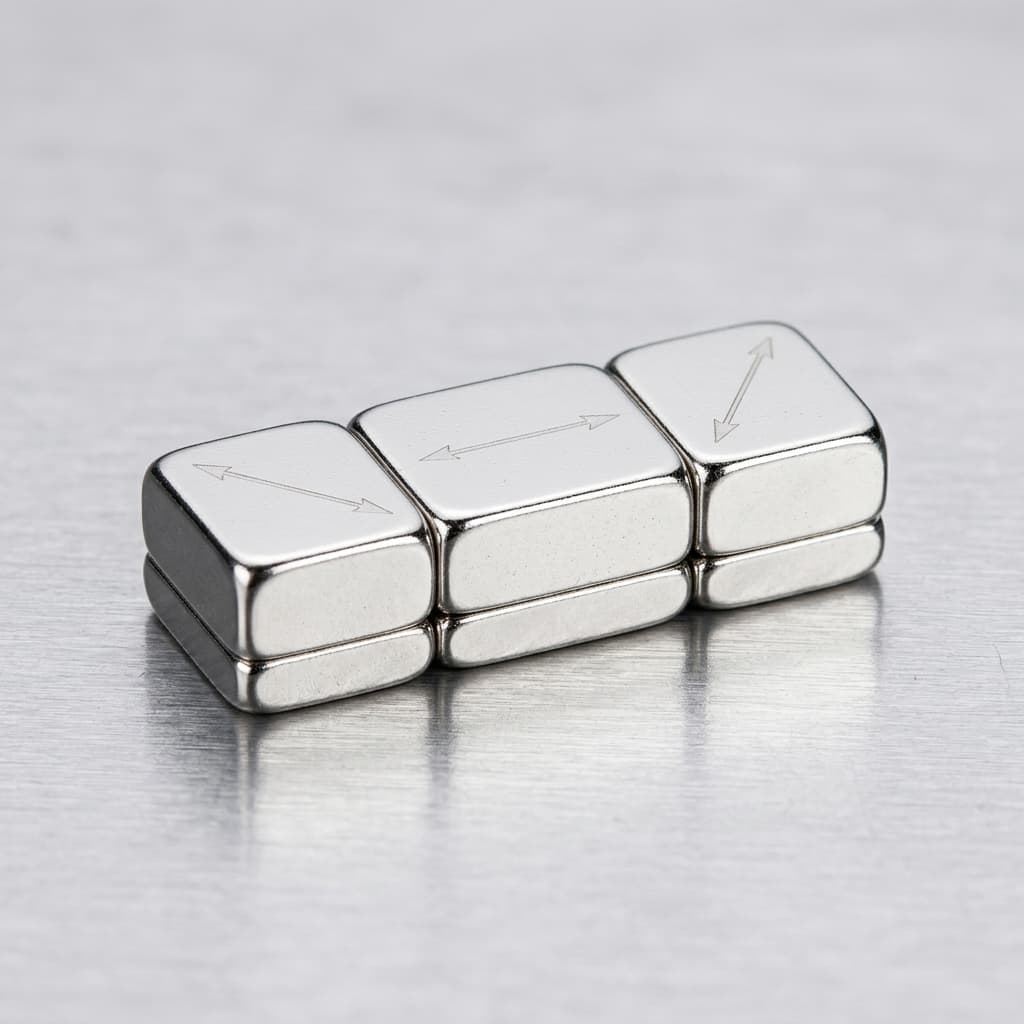
Designing Halbach Cylinders for NMR, MRI, and Scientific Research
Learn how to achieve highly uniform dipole or quadrupole magnetic fields inside a bore using discrete Halbach cylinder assemblies.
When modern scientific instrumentation—such as Nuclear Magnetic Resonance (NMR) spectrometers, desktop MRIs, or particle accelerators—requires an intense, highly uniform magnetic field within an open cavity, traditional electromagnetic coils often prove too bulky, power-hungry, and thermally unstable. Worse, electromagnets require massive liquid helium cooling systems to maintain superconductivity.
One practical permanent-magnet solution to this engineering challenge is the Halbach Cylinder, a specialized ring array capable of generating a useful field within its internal bore while reducing external flux leakage compared with conventional arrangements.
In this guide, we break down the mathematics governing these structures and the severe manufacturing challenges that buyers must anticipate.
1. The Mathematics of Field Topologies
A continuous ideal Halbach cylinder uses a sinusoidal magnetization pattern across its circumference. Because manufacturing continuously magnetized cylinders is economically impractical, industrial Halbach cylinders are constructed by assembling discrete anisotropic magnet wedges or trapezoidal blocks.
By calculating the precise magnetization vector of each discrete segment, engineers can control the magnetic topology inside the bore. The magnetization vector M as a function of the polar angle theta is defined by:
M(theta) = M_r [cos(k theta) r_hat + sin(k theta) theta_hat]Where k is the integer defining the multipole order:
Cross-Section: Dipole (k=1) vs Quadrupole (k=2)
$k = 1$: The Dipole Cylinder
- Field Profile: Produces a uniform, unidirectional magnetic field straight across the internal bore.
- Key Application: Portable NMR spectrometers, benchtop MRIs, and Faraday isolators.
- Why it matters: The field uniformity can reach the ppm (parts-per-million) level required for chemical shift resolution without consuming a single watt of electricity.
$k = 2$: The Quadrupole Cylinder
- Field Profile: Produces a field with zero flux at the exact geometric center that increases linearly towards the inner wall.
- Key Application: Focusing charged particle beams in synchrotrons, linear accelerators, and free-electron lasers (undulators/wigglers).
2. Design Parameters for OEM Procurement
When drafting an RFQ for a custom Halbach cylinder, providing a simple CAD model is insufficient. Your specification document must define the following parameters to ensure the factory understands your optical or medical constraints:
| Specification Parameter | Typical Range | Engineering Implication |
|---|---|---|
| Target Field Strength ($B_0$) | 0.5T to 2.0T | Dictates the Outer Diameter (OD) to Inner Diameter (ID) ratio. High $B_0$ requires extremely thick magnet walls. |
| Field Homogeneity | 10 ppm to 1000 ppm | Dictates the number of discrete segments (e.g., 16, 24, or 32 pieces). More pieces = better homogeneity but exponentially harder assembly. |
| Active Volume (DSV) | Diameter of Spherical Volume | The physical space inside the bore where the homogeneity spec must be met. |
| Operating Temperature | 20°C to 150°C | Determines whether to use Neodymium (NdFeB) or Samarium Cobalt (SmCo). SmCo is required for extreme temperature stability despite lower peak flux. |
3. The Assembly Challenge: Why DIY Fails
While the math behind a Halbach cylinder is well-documented in physics textbooks, the physical execution is notoriously difficult. R&D teams that attempt to glue these together in-house usually face catastrophic failure modes:
- Extreme Repulsive Forces: To create the concentrated internal field, the individual magnet wedges must be forced together against their natural repelling forces. A minor slip during assembly can chip or fracture magnets, damage fixtures, and create safety risks.
- Tolerance Accumulation (The Wedge Problem): A cylinder made of 24 trapezoidal segments relies on tight dimensional control. A machining tolerance error of just 0.05mm per block can compound around the ring, creating closure gaps, uneven adhesive lines, or field error.
- Angular Deviation: The true magnetization angle of raw magnet blocks naturally deviates by 2-3 degrees from their geometric axis during the powder pressing phase. In a Halbach cylinder, this microscopic deviation drastically ruins the parts-per-million (ppm) homogeneity of the internal field. (Read our Sourcing QA Guide for more on angular deviation testing).
Typical Review Finding: Homogeneity Drift
For NMR-style dipole cylinders, off-the-shelf blocks and uncontrolled bonding often create homogeneity drift that is difficult to correct after cure. A stronger sourcing plan defines magnet sorting, angular deviation limits, useful DSV, mapping temperature, and passive shimming strategy before the cylinder is assembled.
4. Our Factory Manufacturing Approach
As a professional magnetic assembly OEM, HalbachArray mitigates these risks through a strict manufacturing pipeline designed specifically for medical and aerospace clients:
- Pre-Sorting by Flux & Angle: We test and sort thousands of raw NdFeB or SmCo blocks, matching them into sets with identical magnetic moments and
< 1.5°angular deviation before assembly begins. - Custom CNC Assembly Fixtures: We machine dedicated non-magnetic aluminum, brass, or specialized resin jigs for custom cylinder projects. These fixtures constrain the blocks while project-specified structural adhesives cure under a controlled process.
- 3D Gauss Verification & Shimming: Post-assembly, a 3-axis Hall probe or controlled scan path can map the bore flux density. If the field requires correction, passive shimming may be reviewed to bring the useful volume closer to the target ppm range.
If your R&D or procurement team is scaling up production for a device relying on Halbach cylinders, use our factory review to reduce assembly scrap risk before pilot production. Submit your dimensional constraints and target field strength to [email protected] for a technical review.
More Posts
Halbach Array Segment Count: 4 vs 8 vs 16 Blocks (Cost & Performance)
Compare Halbach array segment counts across 4, 8, and 16 blocks: flux, ripple, eddy-current risk, cost drivers, QC checks, and RFQ guidance.

Halbach Array vs. Traditional Magnets: When to Choose Which
An engineering comparison between Halbach arrays and traditional multipole magnet rotors for BLDC motors, eVTOLs, and industrial applications.
Understanding Neodymium Magnet Grades for High-Temp Rotors: N52 vs N42SH vs N38UH
A mechanical engineer's guide to selecting the correct NdFeB magnet grade for high-temperature operating environments to prevent irreversible demagnetization.