
Understanding Neodymium Magnet Grades for High-Temp Rotors: N52 vs N42SH vs N38UH
A mechanical engineer's guide to selecting the correct NdFeB magnet grade for high-temperature operating environments to prevent irreversible demagnetization.
When designing a high-performance electric motor—whether it's an axial flux motor for an eVTOL aircraft or a heavy-duty industrial servomotor—one of the most common mistakes engineering teams make is blindly specifying the N52 magnetic grade.
While N52 Neodymium (NdFeB) magnets offer very high room-temperature magnetic flux density, they have a critical vulnerability in many motor programs: poor thermal stability.
In this technical brief, we detail the trade-offs between magnetic strength (Remanence, Br) and resistance to demagnetization (Intrinsic Coercivity, Hcj), and explain why downgrading to a "weaker" grade like N42SH or N38UH is often the only way to ensure your motor survives its thermal envelope.
1. The N52 Trap: High Flux, Low Heat Tolerance
The nomenclature of a Neodymium magnet grade contains two vital pieces of information:
- The Number (e.g., 52): Indicates the Maximum Energy Product (BHmax), measured in MegaGauss-Oersteds (MGOe). Higher number = stronger magnetic field.
- The Suffix (e.g., M, H, SH, UH, EH, AH): Indicates the temperature rating and intrinsic coercivity.
A standard N52 magnet (with no suffix) has a maximum operating temperature of just 80°C (176°F).
In a high-RPM BLDC motor under heavy load, the copper windings in the stator generate intense heat. Additionally, the high-frequency switching of the motor controller induces eddy currents directly onto the surface of the magnets, generating even more localized heat.
If the internal temperature of your rotor exceeds 80°C, an N52 magnet will experience irreversible demagnetization. The motor will permanently lose torque, draw excessive current, and eventually stall or burn out.
Typical Review Finding: The N52 Trap
Compact BLDC and propulsion rotors are often specified with standard N52 to maximize room-temperature output. If the rotor surface exceeds the grade's temperature margin during stall or overload, irreversible demagnetization can reduce torque. A better review compares thermal exposure, Hcj, air-gap flux, and cost before moving to an SH, UH, EH, AH, or SmCo option.
B-H Demagnetization Curve: N52 vs N42SH at 150°C
2. The Trade-Off: Coercivity vs. Remanence
To make a Neodymium magnet survive higher temperatures, manufacturers must add heavy rare-earth elements like Dysprosium (Dy) or Terbium (Tb) into the alloy during the sintering process.
These elements dramatically increase the magnet's Intrinsic Coercivity (Hcj)—its ability to resist being demagnetized by heat or opposing external magnetic fields.
However, adding Dysprosium displaces Neodymium in the alloy, which directly lowers the peak magnetic strength (Br). This is the fundamental trade-off in magnet chemistry: you cannot have the highest strength and the highest temperature resistance simultaneously.
Grade Suffix Benchmark Matrix
| Grade Suffix | Max Operating Temp | Typical Grade Example | Br (Gauss) | Hcj (Oersted) | Best Application |
|---|---|---|---|---|---|
| None (N) | 80°C | N52 | ~14,500 | ≥ 12,000 | Desktop electronics, sensors, low-load robotics. |
| M | 100°C | N50M | ~14,000 | ≥ 14,000 | Light industrial actuators, consumer drones. |
| H | 120°C | N48H | ~13,700 | ≥ 17,000 | Standard automotive, e-bike motors. |
| SH | 150°C | N42SH | ~13,000 | ≥ 20,000 | High-performance BLDC, power tools, eVTOLs. |
| UH | 180°C | N38UH | ~12,300 | ≥ 25,000 | Heavy industrial servos, EV traction motors. |
| EH / AH | 200°C - 230°C | N35EH | ~11,800 | ≥ 30,000 | Aerospace, downhole drilling, extreme environments. |
3. How to Choose the Right Grade for Your RFQ
When preparing your motor's Bill of Materials (BOM), follow this simple framework:
- Calculate the Thermal Envelope: Use thermal simulation software or measured test data to estimate the worst credible peak temperature on the rotor surface during stall or overload.
- Add a Safety Margin: Add 20°C to 30°C to your peak simulated temperature to account for ambient temperature spikes, poor enclosure ventilation, and manufacturing variances.
- Select the Suffix First: If your worst-case temperature + margin equals 140°C, you must select an SH grade (rated for 150°C).
- Maximize the Number: Once you have locked in the SH suffix, select the highest available number for that suffix (e.g., N42SH or N45SH).
A Note on Costs: Dysprosium is an extremely expensive rare-earth element. Therefore, high-temperature grades (UH, EH) are significantly more expensive than standard grades (N, M), even though their raw magnetic pull force is technically lower.
4. SmCo: The Alternative to High-Temp NdFeB
If your motor must operate at temperatures exceeding 200°C, even the most expensive AH-grade Neodymium will struggle. In these extreme cases, engineers must switch entirely to a different alloy: Samarium Cobalt (SmCo).
SmCo magnets (typically the 2:17 composition) can operate in much higher temperature ranges than NdFeB, often up to 300°C to 350°C depending on grade and geometry. While their peak strength is lower than NdFeB, their thermal stability and corrosion resistance can be a better fit for high-temperature or radiation-exposed assemblies.
OEM Support for Your Next Motor Project
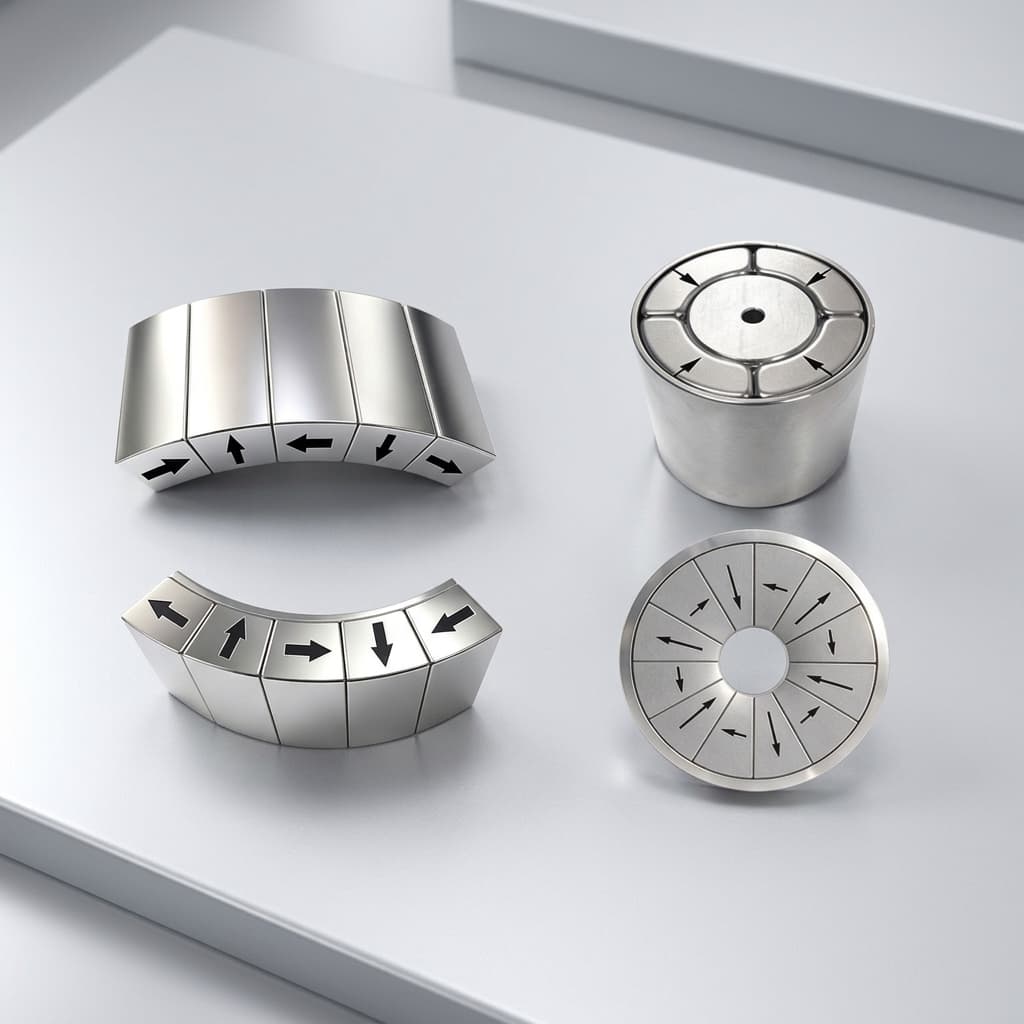
At HalbachArray, we specialize in high-temperature magnetic assemblies. Whether you are pressing N42SH segments into a high-speed carbon-fiber wrapped rotor or bonding SmCo blocks into a Halbach cylinder for a scientific instrument, our engineering team can review material selection before pilot or mass production.
Send your temperature parameters and dimensional CAD files to [email protected] for a material review and OEM quotation scope.
Author

Categories
More Posts
Preventing Thermal Demagnetization in Halbach Arrays: Grade Selection and GBD Guide
Guide to Halbach array thermal demagnetization, magnet grade selection, GBD limits, supplier validation, and RFQ checks for engineering teams.
Designing Halbach Cylinders for NMR, MRI, and Scientific Research
Learn how to achieve highly uniform dipole or quadrupole magnetic fields inside a bore using discrete Halbach cylinder assemblies.
Halbach Array Adhesives and Encapsulation: A Procurement Guide for Extreme Environments
Use RFQ checks to select structural epoxies, potting compounds, and retention sleeves for high-speed, high-temperature Halbach arrays.